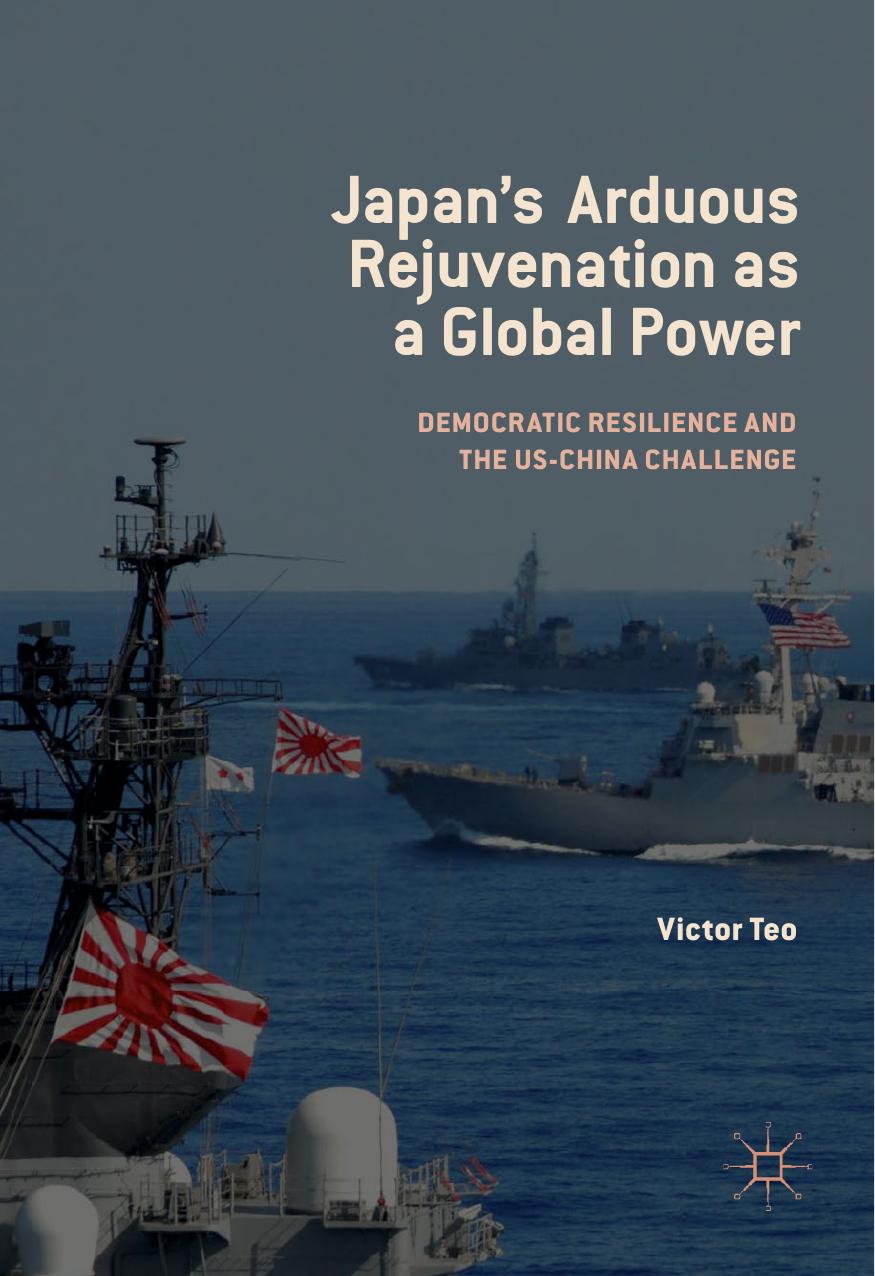
Japan’s Arduous Rejuvenation as a Global Power by Victor Teo
Author:Victor Teo
Language: eng
Format: epub, pdf
ISBN: 9789811361906
Publisher: Springer Singapore
Cautioning America’s Unilateralism
There are of course politicians and segments of Japanese society who have imperatives to seek some sort of rebalance in Japan’s relationship with the US, particularly with the election of Donald Trump. There are two reasons. The first of course has to do with Japan’s indigenous development. The Cold War is over and Japan is no longer the weak, defeated nation it was after the Pacific War. The US-Japan alliance was conceived for a very different purpose and under very different circumstances. There is a recognition that even though the Yoshida Doctrine has served Japan well, it was also a shrewd neo-realist realpolitik maneuver on the part of Japan to make the best use of its circumstances at that time. The Yoshida Doctrine provided a shield used by successive Japanese prime ministers to resist US pressure for Japan to rearm or commit politically and militarily to fight the Cold War. Even though pacifism and the Yoshida Doctrine is being sold as a liability of the past and a legacy of the San Francisco system, the truth is that it was a question of judgment and interpretation of the Kantei (prime minister’s office) as to which strategic direction to lean toward. Over the past two decades, the neo-conservatives have successfully managed to direct the political and strategic narratives to cast China as the dominant threat, and the US as the dominant savior and friend that can help Japan enhance its own security and protect its freedom. At another level, it might be even possible that the Japanese elites believe that only through the tightening of its embrace of the US, would it be bestowed with the trust and the latitude to rejuvenate as a global power. This is not something new.
Back in the 1970s, it was abundantly clear that Japan then was already keen to use its new-found economic strength in order to increase its power and leverage over the countries it provided assistance to. By the late 1980s, Japan was no longer the “weak” war-torn nation in the aftermath of the Second World War.4 In military terms, Japan possesses the most formidable hardware in the whole of East Asia. It is only natural that Japan would seek to achieve political status commensurate with its level of economic development. However, by the 1980s, there were increased strains in the US-Japan relations, as politicians and scholars in the US debate the strength of their ally. The incessant Japanese purchase of prime real estate in Manhattan and Los Angeles, the rise of Japan’s technological and manufacturing prowess and the dominance of the Japanese yen all but suggest that, in its economic ascent, Japan would threaten to overshadow the US. Japan’s rise during the 1980s foreshadowed a similar path that China would take about three decades later. Yet, by the 1990s, Japan’s rise was stymied by a variety of political and economic factors, but many Japanese commentators privately groused that US containment was at least part of the reason for Japan’s failed rejuvenation.
Download
Japan’s Arduous Rejuvenation as a Global Power by Victor Teo.pdf
This site does not store any files on its server. We only index and link to content provided by other sites. Please contact the content providers to delete copyright contents if any and email us, we'll remove relevant links or contents immediately.
| Anthropology | Archaeology |
| Philosophy | Politics & Government |
| Social Sciences | Sociology |
| Women's Studies |
Born to Run: by Christopher McDougall(7127)
The Leavers by Lisa Ko(6948)
iGen by Jean M. Twenge(5415)
Sapiens by Yuval Noah Harari(5370)
Spare by Prince Harry The Duke of Sussex(5197)
The Kite Runner by Khaled Hosseini(5179)
Machine Learning at Scale with H2O by Gregory Keys | David Whiting(4313)
Bullshit Jobs by David Graeber(4190)
Never by Ken Follett(3957)
Goodbye Paradise(3810)
Livewired by David Eagleman(3773)
Fairy Tale by Stephen King(3398)
A Dictionary of Sociology by Unknown(3085)
Harry Potter 4 - Harry Potter and The Goblet of Fire by J.K.Rowling(3073)
The Social Psychology of Inequality by Unknown(3031)
The Club by A.L. Brooks(2925)
Will by Will Smith(2919)
0041152001443424520 .pdf by Unknown(2845)
People of the Earth: An Introduction to World Prehistory by Dr. Brian Fagan & Nadia Durrani(2736)
